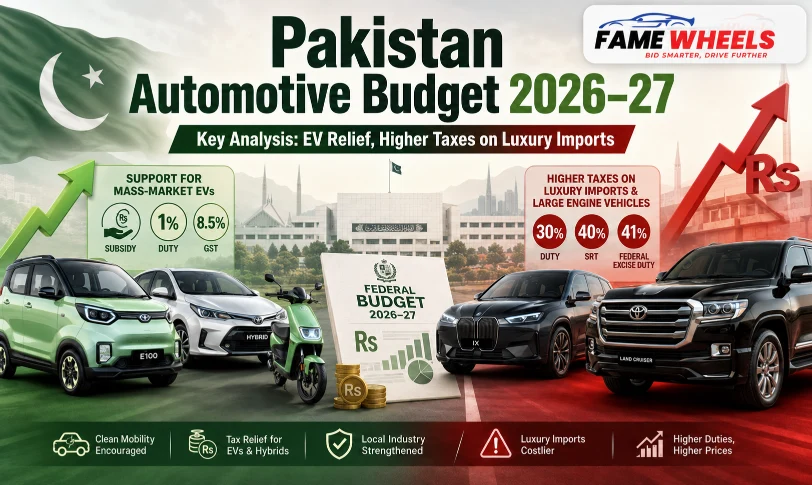

In the Federal Budget 2026-27, a series of regulatory adjustments has been introduced to the automotive industry in Pakistan. Instead of an increase in taxes for EVs, the government has taken a more targeted approach, protecting the mass-market EVs and setting heavy new taxes on imports and high-displacement petrol cars. This blog examines the most significant policy changes and their impact across various markets.
Luxury Imported EVs Face New Federal Excise Duty
Federal Excise Duty (FED) coverage has been extended to high-end foreign electric vehicles for the first time. The government has created a progressive duty system that depends on the value of the car:
| Vehicle Category | FED Rate | Policy Rationale |
| Imported CBU EVs up to Rs 2 crore | 0% | Protects mass-market EV access |
| Imported CBU EVs between Rs 2-3 crore | 30% | Targets the premium luxury segment |
| Imported CBU EVs exceeding Rs 3 crore | 40% | Discourages ultra-luxury imports |
The Finance Minister’s logic was clear: Green subsidies are not meant for those who buy luxury electric vehicles with higher specifications. Elite imported electric vehicles will have to pay a heavy price once the FBR rates are fully implemented; meanwhile, affordable and mid-range EVs will be spared.
Heavy Engine Vehicles Face Increased Tax Burden
The budget places strict limits on engine size on imported Completely Built Units (CBUs) and locally-made vehicles over 2,000cc.
| Engine Capacity | FED Rate | Affected Models |
| 2,000cc to 3,000cc | 40% | Toyota Fortuner, Toyota Revo, premium SUVs |
| Above 3,000cc | 41% | Luxury sedans, high-end imports |
This heavy engine vehicles policy is a clear policy of driving towards the use of smaller, more efficient vehicles. The invoice prices for popular locally built SUVs and premium sedans in this model segment will skyrocket.
Mass-Market EVs and REEVs Receive Extended Relief
The sales tax of 18% on EVs, as originally thought in pre-budget speculation, failed to materialize. The government has decided not to disrupt the EV ecosystem but to continue to support it.
Sales Tax Protection
The 8th Schedule to the Sales Tax Act continues to apply 8.5% sales tax on locally manufactured hybrid vehicles up to 1800cc and 1% on locally manufactured EVs. Range-Extended Electric Vehicles (REEVs) are neither redefined nor penalized and remain categorized under existing EV definitions.
Customs Duty Extension
The 1% customs duty applicable to EV-specific CKD components has been extended until June 30, 2027, under the Fifth Schedule of the Customs Act. The 25% customs duty relief for imported CBU (chassis-based) Four Wheel Drive EVs under $50,000 has also been extended.
Commercial EV Incentives
There has been a proposal for a 1% sales tax on imported electric trucks, reflecting a trend toward electrification of commercial freight.
Electric Two-Wheelers Not Affected
There have been no plans to increase the taxes on electric motorcycles and scooters. Maintaining the existing duty regime with 1% customs duty on parts and components used in the production of EVs. That makes e-Bikes more accessible for everyday users and helps grow the EV market.
Tax Incentives for Local Manufacturers
Each year after extensions, the government has rolled out the Pakistan Accelerated Vehicle Electrification (PAVE) to provide subsidized financing for E-rickshaws and E-bikes. The budget provides Rs. 23.86 billion in concessions for CKD kits and EV parts, including local battery packs up to 50kWh.
The policy direction is very clear that Pakistan is going from a trading market towards a manufacturing ecosystem. High-level imported parts are an insufficient basis for real electric mobility. The policy also aims to maintain CKD incentives for the manufacture of electric cars, SUVs, motorcycles, and battery packs in the country.
Token Tax Overhaul for Islamabad
The registration of bigger engine vehicles in Islamabad Capital Territory has been shifted from fixed token tax to PS-driven token-based tax. In the Finance Bill, the calculation is based on a percentage of the car’s invoice value:
| Engine Capacity | Annual Token Tax Rate |
| 1,001cc to 2,000cc | 0.25% of invoice value |
| Above 2,000cc | 0.35% of invoice value |
The Pending NEV Policy
The Finance Bill 2026 failed to address the issue of how to classify REEVs and PHEVs. A new Energy Vehicle (NEV) policy is being developed in a special committee set up by the Prime Minister, and is due for presentation to Parliament after cabinet approval at the federal level.
Industry insiders believe this forthcoming NEV policy will definitively categorise REEVs and PHEVs and lay out their long-term tariff structures. REEVs are budgeted through this budget.
Automotive sector in Budget 2026-27
| Vehicle Category | Policy Update | Market Impact |
| Imported EVs (Rs 2 crore+) | New tiered FED (30%-40%) | Significant price increase |
| Imported CBUs (2,000-3,000cc) | 40% FED imposed | Major cost rise |
| Imported CBUs (3,000cc+) | 41% FED imposed | Highest tax burden |
| Locally assembled EVs & REEVs | 1% sales tax extended | Price stability |
| Locally assembled hybrids (up to 1800cc) | 8.5% sales tax retained | No change |
| Electric bikes & scooters | Existing duties unchanged | Affordable mobility maintained |
| Commercial electric trucks | Proposed 1% sales tax | Logistics sector incentive |
Conclusion
Overall, Budget 2026-27 is consistent with a dual strategy: to curb imports of luxury goods while investing more heavily in the local EV sector. Mass-market EVs were spared the tax hikes, large conventional engines were hit with substantial new duties, and luxury electric imports lost their tax-free status.
These reforms will encourage consumers to buy locally made EVs and fuel-efficient models and also propel domestic manufacturing and future industry development. The government is influencing consumer behavior through the tax code.