
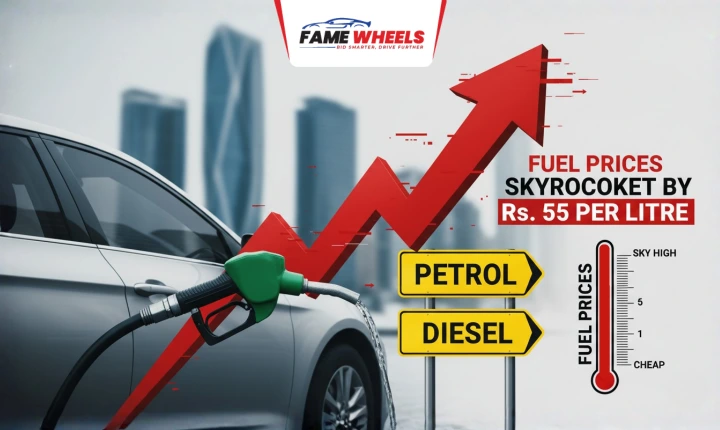

The government declared a significant increase in fuel prices. The increase will be to both petrol and diesel, by Rs. 55 per liter, beginning on March 7, 2026. This is a big blow to the consumer who is concerned with inflation.
In Islamabad, Petroleum Minister Ali Pervaiz Malik said the increase happened due to increasing tension in the Middle East following the Iran- US- Israel conflict. The oil flows via the Strait of Hormuz were disrupted by the war. The heavy-importing countries like Pakistan were forced to pass that burden onto consumers.
At midnight, the new rates start. This is the highest level of fuel prices since 2023. Citizens in big towns lined up to fill their tanks before the upsurge.
| Product | Old Price (Rs.) | New Price (Rs.) | Difference (Rs.) |
| Petrol | 266.17 | 321.17 | +55.00 |
| High‑Speed Diesel | 280.86 | 335.86 | +55.00 |
The increase is approximately 17% on petrol and 20 % on diesel. It is among the sharpest price increases in Pakistan ever.
Why the Massive Hike?
Oil Supplies are Interrupted by Middle East Conflict.
The increase in price results after a spike in enmities between the United States, Israel, and Iran. Iranian Revolutionary Guards reported that the Strait of Hormuz had been shut. They threatened to attack ships.
Several of the world’s oil trade (approximately 20 million barrels a day) passes through the Strait. It is the energy corridor that is most important. Most of the imports of crude and petroleum in Pakistan depend on it.
Increase in Global Oil Prices
The international markets responded with a shock:
- Brent crude climbed 8.5 percent to approximately 92-93 a barrel.
- West Texas Intermediate rose over 12 % to past 90 per barrel.
- Crude weekly gains were close to 30 that is the biggest gains in decades.
According to Petroleum Minister Malik, the government was forced to transfer the cost to consumers because of extreme global oil volatility. Deputy Prime Minister Ishaq Dar added that global petroleum costs had gone up 50-70 %.
Government Action: Weekly Review
Change to Weekly Price Reviews. The government changed its price review period to weekly. The alteration enables them to respond better to market fluctuations worldwide.
Malik informed the world: “Once the circumstances stabilize globally, we will reduce prices immediately.”
Popular Response: Panic Purchasing and Long-Lines
By the time of midnight, queues at Karachi, Lahore, and Islamabad petrol stations were very long. Drivers drove to gas stations to fill up before prices went up.
Other stations have closed some of their pumps, stating that they are unable to sell at the previous prices.
Imran Hussain, a Lahore station business owner, remarked, “I have been waiting 70 minutes to have my turn.”
Strict measures against hoarding were enforced by Prime Minister Shehbaz Sharif. He threatened to shut down petrol pumps due to artificial shortages and revoke their licenses.
Warning Against Hoarding
For his part, the Petroleum Minister threatened to take measures against those who played with supply to get unlawful profit. We will take any action against any individual who chooses not to sell petrol at a profit.
Law enforcers broke down operations in Punjab and other provinces. Violators were ordered to be prosecuted by deputy commissioners.
Conclusion
The increase in fuel prices to Rs. 55 per liter in Pakistan is one of the highest in the history of this country. It is occasioned by a global oil crisis, which is a result of the Middle East war. The Strait of Hormuz is closed, and it is not going to be fixed in the short term, thus subjecting the consumers to consistent volatility.
The step by the government to hold weekly reviews and provide alternative routes across the Red Sea generates some hope. But, Petroleum Minister Malik said, “The fire, which started in a neighboring nation, has spread throughout the region. No definitive timeframe for the crisis termination.
At least Pakistani consumers have to struggle with high fuel prices and a lack of energy prospects.
Frequently Asked Questions
Both petrol and diesel have increased by 55 per litre each. On March 7, 2026, the cost of petrol is Rs. 321.17, and the cost of diesel is Rs. 335.86.
The increase is the result of the current Middle East war between Iran, the U.S., and Israel. The war has also shut the Strait of Hormuz, an important passage through which Pakistan imports its oil, leading to a global spike in crude prices.
The government has changed to weekly price reviews because of the volatility of the market. The prices will be reconsidered on a weekly basis and reduced once the world situation gets better.
The government is promising that there are sufficient petroleum reserves in Pakistan that can sustain 28 days. There are other supply channels that have been secured through the Red Sea, and the government is trying hard to prevent hoarding.
Strict measures have been taken against fuel hoarders by Prime Minister Shehbaz Sharif. Artificial shortages made by petrol pumps will be shut down immediately, the licence will be revoked, and prosecuted in court.