
Knowing what Types of EVs there are is no longer a rich person’s thing that car buyers shopping for new cars in today’s evolving auto industry can afford to ignore. An observer of the automotive upheaval in South Asia and a consultant to mobility-related brands for over 10 years, I’ve witnessed how EVs are gradually altering buyer preferences in Pakistan, especially here in Karachi, where one’s everyday driving decisions can change as rapidly as fuel costs and city traffic.
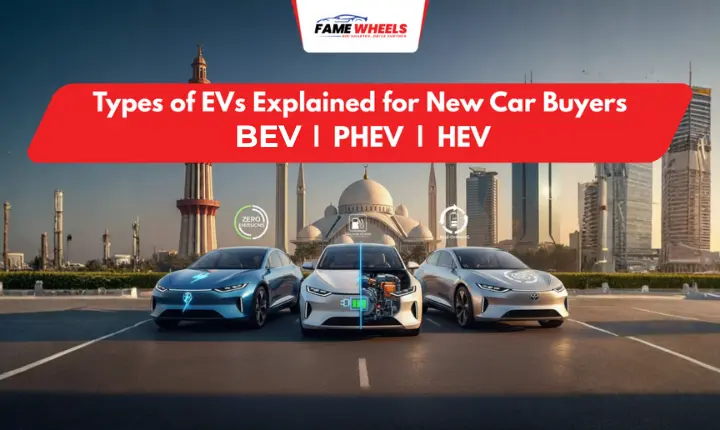
There is no single thing called an electric vehicle. Depending on how they store energy, charge, and run on the road, there are three practical types of fuel-cell vehicles. These are Battery Electric Vehicle (BEV), Hybrid Electric Vehicle (HEV), and Plug-in Hybrid Electric Vehicle (PHEV). All demand to a range of budgets and also for drivers.
What Are the Different Types of EVs?
Battery Electric Vehicles BEV
BEVs are pure electric vehicles and do not consume petrol or diesel. The motor is powered by stored energy from a large battery.
In the real world, BEVs suit people who live in cities and have fairly predictable daily driving. Charging may take place at home or at public charging points. Battery life depends on your use and the climate, but new systems are built to last for a few years of demanding use.
Key benefits
- Zero carbon emissions and low environmental impact
- Very low maintenance since there is no engine oil or exhaust system
- Quiet and smooth driving experience
Considerations
- Higher upfront cost for new cars
- Charging infrastructure is still developing in Pakistan
- Long trips require planning around charging access
Plug-In Hybrid Electric Vehicles PHEV
PHEVs include a rechargeable battery and a traditional fuel engine. They can be powered by electricity over short distances and switch to fuel when the battery runs out.
PHEVs are for Karachi buyers who want electric driving but don’t want to rely entirely on charging stations.
Key benefits
- Can be charged at home and driven on fuel when needed
- Lower fuel consumption compared to conventional cars
- Reduced range anxiety
Considerations
- Maintenance cost can be higher due to dual systems
- Battery range on electric mode is limited
- Slightly more complex technology
Hybrid Electric Vehicles HEV
HEVs do not plug in. The battery is charged by regenerative braking and the engine. Electric power aids the engine rather than replacing it.
This is usually the most feasible starting point for EVs in Pakistan, especially if you’re a buyer coming from petrol cars.
Key benefits
- No need for charging infrastructure
- Better fuel efficiency and lower emissions than traditional cars
- Proven safety and reliability
Considerations
- Cannot drive fully electric for long distances
- Environmental benefits are moderate compared to BEVs
- Less future proof for full electrification goals
Cost Charging and Ownership Experience
Price is always a consideration when shopping for EVs. BEVs generally have the lowest operating costs but the highest upfront costs. HEVs are cheaper to buy and easier to maintain. PHEVs sit between the two.
Charging convenience matters. Home charging is perfect, but it can’t always happen in apartment life. A battery’s health benefits from moderate charging and avoiding extreme heat or cold.
Safety and Environmental Impact
All EVs are built to strict safety standards and are equipped with advanced braking systems & passive protection of the battery box. In terms of reducing emissions, BEVs have the largest impact, followed by PHEVs and HEVs.
Conclusion
The decision on the types of EVs depends on lifestyle, budget, and charging access. BEVs are efficient and clean, especially for daily urban use. For flexibility, PHEVs make sense. For comfort and familiarity, HEVs are still a good choice. And knowing these differences, say experts, is what will guide buyers in making long-term decisions they can look back on with confidence one day.
FAQs
BEVs are best suited for routine city driving, as they offer low running costs and punchy performance.
Yes, current EVs are reliable if well-maintained and not just abused, like all outdoor equipment.
Not necessarily. They can run on fuel when the battery is not fully charged.
Battery replacement is expensive, but most manufacturers offer very long warranties that mitigate the risk.
BEVs are the best in this regard, as they require the least maintenance (fewer mechanical parts).